

本站推荐电影
-
·灵巧手出货量翻倍背后:电子皮肤与传感器率先迎来“质的变化”
·伊利股份拟最多回购20亿元 全部注销!陈发树加仓
·宫崎英高本人都认可的角色!重甲高伤胖宝宝
·网易二次元都市冒险游戏《无限大》官宣 2027 年 1 月 15 日全球上线
·博主开智界V9被日产奇骏追尾:连续撞了四次才停下
·“曾小贤”回应了!网传《爱情公寓》即将回归
·世界杯预选赛中国男篮不敌澳大利亚队
·今天奥克兰高速接连车祸 一特斯拉撞毁
·全市巡察工作会议暨十三届市委第八轮巡察工作动员部署会召开
·Pawan Kalyan's Ustaad Bhagat Singh Set for First Single Launch
·英伟达 战略入股电力开发商!锁定AI工厂的“电力第一公里”
·亚马尔被换下后不悦,巴萨名宿批评:任何球员都不能这么自私
·刷新亚洲纪录夺冠!17岁中国“小孩姐”起飞
·财务造假!佳缘科技将被ST 24日停牌
·1个名额!重压之下,樊振东缺席世乒赛,温瑞博能否扛起国乒新希望
本站推荐电视剧
-
·东南亚旅游降温:游客“亏钱”退订泰国旅游产品,春节期间上海往返曼谷机票降价近四成
·意大利足协:受疫情影响2020至2021年意大利球场门票收入几乎为零
·淅川:多元业态深度融合 激活暑期文旅经济
·B'desh will get stuck in China's debt trap like SL & Pak: Media expert
·零跑汽车:上半年净利润2.1亿元
·AT无视成本大把花钱:一个交通项目建28个人行横道
·印度Redmi Note 10 Pro更新MIUI 13后相机崩溃,官方提供免费维修_用户_机型
·喝点水,尿就多,这是提示肾好?还是肾虚呢?今天一次讲清楚
·乐福追忆16年夺冠骑士:铸就了独一份的兄弟情谊
·2026中国网络媒体足球精英赛赛程公布
·世界杯决赛处罚来了!
·UK Prime Minister Liz Truss announces resignation
·开季遭利兹双杀且0进球!格拉斯纳:问题不在战术上,失误太多了
·风云A9L订单获51971台 预售15.99万元起 将于7月8日正式上市
·【成长·传承】今日冬至
电影下载排行
-
·汪苏泷发文感谢阿信,并表示:不再“胡乱相遇”,二人合作新歌《笨蛋》在演唱会上首唱;阿信曾强调汪苏泷的演唱赋予歌曲新生命力
·优地机器人通过港交所上市聆讯
·从震动硅谷到喊话马斯克“欢迎掰手腕”,Kimi做对了哪些
·区领导“八一”前夕开展走访慰问活动
·科学家开发新技术 可以大规模生产生物降解微型机器人
·欧科亿:本次计提各项减值准备对公司合并报表2026年半年度利润总额影响约2404万元
·Token不够用了!AI时代最火“新生意”|WAIC观察
·从煤矿到AI漫剧 山西吕梁数智化布局“破圈”提速,从煤矿到AI漫剧 山西吕梁数智化布局“破圈”提速
·“绿色通道”服务特殊群体
·多部门联合开展“安全生产月”集中宣传活动
·超节点、超集群、TPU方案涌现 算力“拼系统”时代产业最关心Token性价比|WAIC观察
·国家喊话“涨工资”,开始了
·卡福:阿诺德和卡瓦哈尔有些类似,若他加盟对皇马价值极高
·现货白银日内涨1%
·国台办:两岸民间交流具有很强内生动力,呈现新特点新亮点_朱凤莲_台生
电视剧下载排行
-
·据称,该应用很擅长立即播放世界杯赛事的势头,央视电视台正在起诉500万人的索赔。
·Peskov Explains Why Putin Will Not Congratulate Biden and Americans on Independence Day This Year
·国际空间站掉下来的垃圾,把人家房子砸了个窟窿?!
·海地首都附近遭帮派袭击致40余人死亡
·恶劣天气送关键单沟通顾客后被美团外卖无故扣款
·小红书把春节营销玩明白了
·胡锡进:张丹丹为什么会说这番冷漠无情的话?我百思不得其解
·重庆体彩以公益为笔,绘就九龙坡区乡村幸福生活图景
·建昌县与凌源市建立大凌河保护公益诉讼协作机制
·曝勇士用训练营合同招揽本西 或奔赴湾区试训
·这台卖2000元的翻盖手机,真有点好看啊
·银河航天实现中国商业航天企业首次面向东南亚整星出口
·抚顺县开展燃气安全专项整治工作
·泽连斯基:乌军“头等要务”是守住哈尔科夫
·世界杯不能卖!欧足联强硬宣战!国际足联摊上事了
夜行书生
-
发布时间:2026-08-26
天下无双
Air France-KLM tells GT their ban on portable air conditioners as baggage at Shanghai airport 'out of operation, safety reasons'_我的网站

一 |
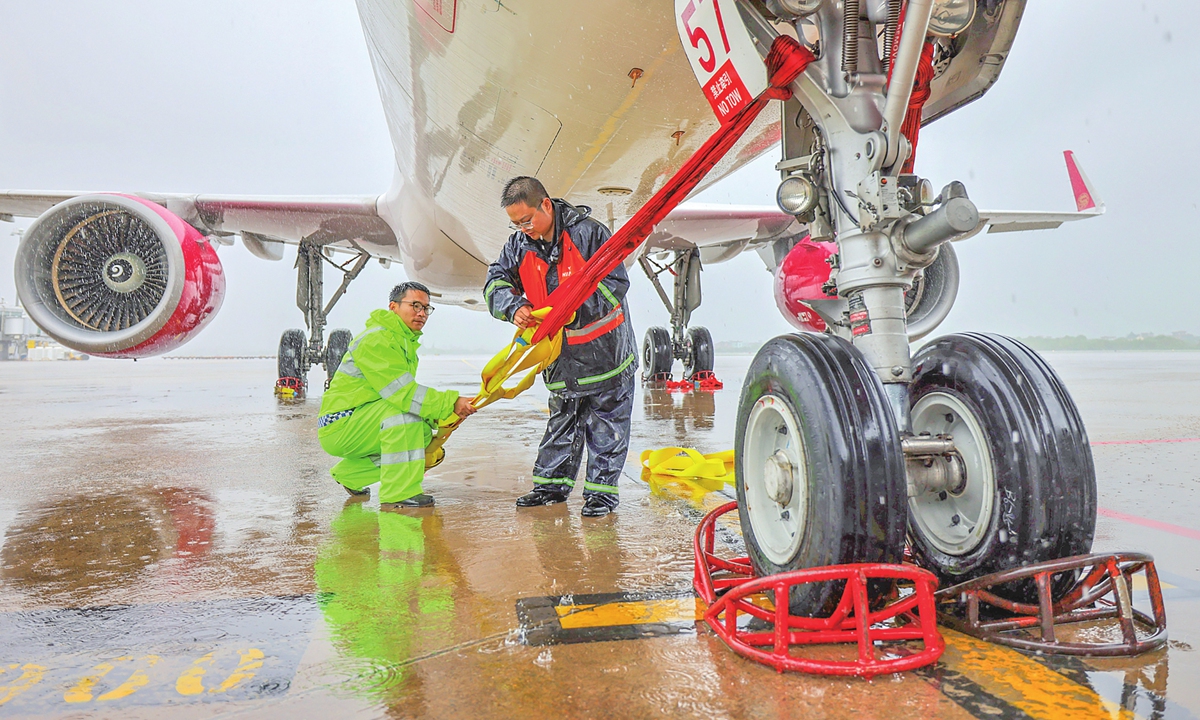
Typhoon Dolphin made landfall in Taizhou, East China's Zhejiang Province, on Sunday afternoon, bringing strong winds up to 42 meters per second and heavy torrential rain to the coastal regions amid a red alert - the highest level in the country's typhoon warning system - issued for it earlier that day.
Authorities in East China's Fujian have relocated nearly 100,000 residents, while coastal provinces are suspending railway services and canceled flights, making an all-out effort to mitigate possible risks.
The NMC maintained orange rainstorm and blue severe convective weather alerts at 6 am on Sunday, forecasting exceptionally heavy rainfall of 250 to 440 millimeters in some areas along the eastern coast of Zhejiang, with heavy to torrential rains expected across Jiangsu, Zhejiang, Shanghai, and Anhui between Sunday morning and Monday morning, China Central Television (CCTV) reported.
In response to the typhoon, China's meteorological authority on Sunday upgraded its emergency response for severe meteorological disasters from Level III to Level II.
Fujian raised the emergency response level for typhoon prevention to Level II at 9 am on Sunday.
As Typhoon Dolphin gathers strength and approaches the coastal areas, Fujian's flood control authority, as of 6 pm on Saturday, deployed a total of 17,800 officials to and relocated 98,900 people from high-risk areas, Xinhua News Agency reported on Saturday.
Fujian has suspended all 115 marine engineering projects and moved 290 construction vessels to safe waters, while 55 passenger ferry routes in affected waters have been halted, chinanews.com reported.
Meanwhile, railway services in the affected regions including Fujian, Zhejiang, Shanghai have also been suspended from Sunday to Monday, according to chinanews.com.
Fujian authorities have urged stronger safety measures for returning vessels, offshore platforms and coastal and island tourism, as well as reinforcement of aquaculture facilities. They also called for timely evacuations from flood- and landslide-prone areas to guard against secondary disasters from the typhoon and heavy rain, chinanews.com reported.
In Zhejiang, Wenzhou city has closed all 85 A-level national tourist attractions, turned away more than 7,400 visitors and evacuated over 1,600, with the relocation effort ongoing, according to CCTV. Next, Wenzhou will next implement a "five suspensions" policy, halting outdoor group activities, classes, work, business operations and transportation.
All fishing vessels at Shitang Fishing Port in Wenling, Zhejiang, have returned to port, with all personnel evacuated ashore and maritime rescue teams on standby. Authorities urged vessels to stay off the sea during the typhoon.
In Shanghai, Pudong and Hongqiao airports operated at reduced capacity on Sunday, with nearly 60 percent of flights canceled. A total of 1,384 flights are scheduled to be canceled including 871 at Pudong and 513 at Hongqiao. Passengers are advised to check with their airlines for the latest updates and adjust travel plans accordingly, according to CCTV.
According to Hu Xiao, meteorological analyst at the NMC, the typhoon has several notable features, including its strong intensity and expansive circulation. The typhoon also has several unusual features. Forming unusually far east, near 180°E, it has traveled more than 7,200 kilometers, making its potential landfall in China a rare event and possibly the easternmost such landfall since 1951. Its 12-day lifespan is also well above the typical seven-to-10-day average, CCTV reported.
According to Ma Jun, director of the Institute of Public and Environmental Affairs, Typhoon Dolphin traveled a long distance and remained at typhoon or severe typhoon strength of its lifespan so far. Despite passing through some areas that were unfavorable to its development, its powerful inner core remained intact, while its extensive cloud system continued to absorb moisture and energy, fueling the potential for torrential rainfall.
The typhoon has remained at sea for more than 260 hours and experienced a rare "three rises and three falls" in intensity. Its unusually long lifespan has allowed it to absorb more moisture and energy, while repeated intensity fluctuations have complicated forecasts of its future track and intensity of wind and rainfall, according to CCTV.
After landfall, Typhoon Dolphin may move slowly, prolonging heavy rainfall and raising the risk of extreme precipitation and related disasters. Its track later in the week remains uncertain as it could interact with the southwest monsoon and cold air from the northwest, potentially broadening and intensifying its impacts, Ma told the Global Times on Sunday.
。

二 |
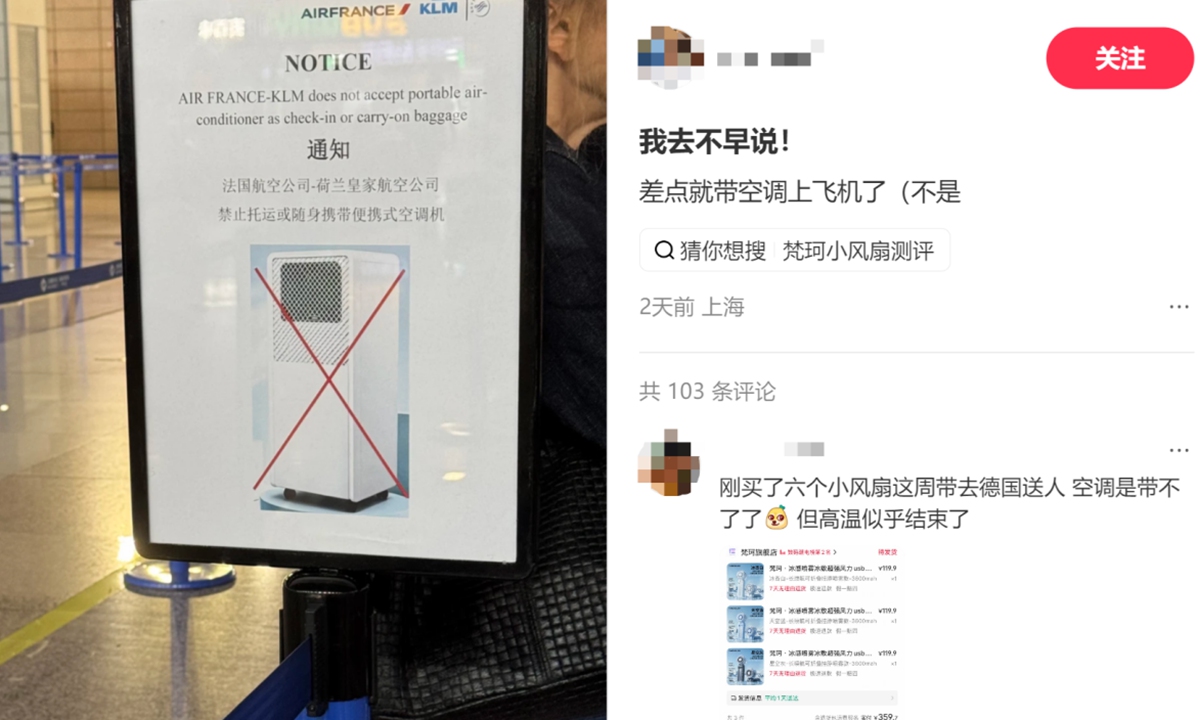
A Rednote post recently sparked discussion and jokes among netizens after showing a notice stating that "Air France-KLM does not accept portable air conditioners as checked or carry-on baggage," against the backdrop of extreme heatwaves in Europe this summer and the difficulty of securing one in European markets.
Air France-KLM customer service later confirmed to the Global Times on Monday that the restriction was in place, explaining that passengers' baggage must comply with relevant rules and requirements, which are established based on operational and safety considerations.
The discussion came as Europe has been hit by persistent extreme heat in recent months, triggered widespread heat alerts and a surge in local demand for air conditioners, a product that was not widely installed in European households.
After the RedNote post was released, some netizens shared similar experiences in the comments section, with one writing: "I just bought six small fans to take to Germany as gifts, [now that] Air conditioners are out of the question. But it seems the heatwave is finally over."
Some speculated that the sign was put up after travelers to Europe tried to imitate a widely reported case in which a Chinese employee based in Shanghai helped a French colleague visiting China on a business trip bring an air conditioner from China back to Europe by air in July.
The story was shared by the Chinese employee on RedNote. After researching different models, the Chinese selected a compact unit suitable for international transport based on its size and weight. The air conditioner reportedly used non-flammable R410A refrigerant, with a refrigerant charge of 350 grams, and contained no lithium battery. According to the post, the netizen concluded that the unit could be transported as regular baggage transport rather than being treated as dangerous goods.
The netizen also carefully consulted the ICAO technical instructions and IATA dangerous goods regulations to determine whether the air conditioner needed to be handled as dangerous goods, per the post.
The French colleague, with sufficient baggage allowance, only paid for additional packing services. The total cost came to 1,412 yuan ($209.26), including 1,260 yuan for the air conditioner, 130 yuan for airport packaging, and 22 yuan for a high-power European power adapter.
The French passenger was reportedly transported the air conditioner successfully and arrived in Barcelona.
However, airlines have reminded passengers that while some air conditioners may qualify for checked baggage, strict requirements still apply.
Battery and refrigerant restrictions must be followed, as portable air conditioners containing lithium batteries are strictly prohibited from being checked in. Meanwhile, size and weight limits must be considered as the equipment must comply with airline baggage allowances, which typically limit individual pieces to 23 kilograms or 32 kilograms, and total dimensions generally not exceeding 158 centimeters.
Professional packaging is also recommended, with travelers advised to use airport packing services to reduce the risk of damage during baggage handling.
Experts said that as Europe continues adapting to increasingly frequent heatwaves, the unusual trend of travelers carrying cooling equipment across borders highlights growing concerns over climate extremes, while also serving as a reminder that aviation safety rules remain a key consideration for transporting household appliances.
In second quarter of 2026, China-Europe freight trains have transported more than 100,000 portable air conditioners and key components, with a total cargo value of about $52 million, helping to ease supply pressures in the European market, according to a report by China Railway Group media.
。

三 |
Current article:http://mptizz.sunaichitikouchua.bond/list_2fu/ji8l5.html
Published on:15:49:20
下载地址2:点击进入迅雷高速下载 温馨提示:邀请好友一起下,可提高下载速度,若遇无法下载,可另选时间尝试或重装软件!
下载方法:安装软件后,点击即可下载,谢谢大家支持,欢迎每天来!